Bill Hwang
Hwang made a name for himself as Robertson's beloved "genius protégé." In 2001, he went independent and founded the Tiger Asia Fund, earning the nickname "Tiger Cub." The fund generated average annual returns of 16%, and at its peak had over $5 billion under management. In 2002, he also earned more than triple returns by investing in Hanmi Pharmaceutical. Hwang rose to Wall Street stardom. However, in 2012, he was struck down by both Hong Kong and U.S. authorities for trading Chinese bank stocks using insider information and liquidated the fund. At the time, he paid $44 million in fines alone. Afterward, he led a fund called Archegos that managed only money from family and acquaintances. The fund had about $7 billion in assets.
Archegos used a strategy of picking a few promising stocks and investing heavily in them. ViacomCBS and Discovery in the U.S., and U.S.-listed Chinese companies Baidu, Tencent Music, and GSX Techedu were among the companies Archegos invested in heavily. Archegos took out massive loans from banks during its investments. Nomura and others reportedly lent far more than normal, eyeing Bill Hwang's "name value" and the stock trading commissions his massive fund scale would generate.
Stock Prices Plunge Under Short Sellers' Attack
If you invest with borrowed money, you can earn more than enough to offset interest when stock prices rise. But the problem with this "debt investing" is that losses also grow just as much when stock prices fall. If you invest 100 million won of your own money and the stock halves, you lose only 50 million won. But if you borrow 400 million won and invest a total of 500 million won, you lose 250 million won. Far from earning interest, you lose your entire principal and have little hope of repaying the bank. To prevent this risk from growing too large, banks ask clients to deposit more cash when stocks bought with their money fall to a certain degree. This is a "margin call." If you cannot put up the money, the stocks are forcibly sold.
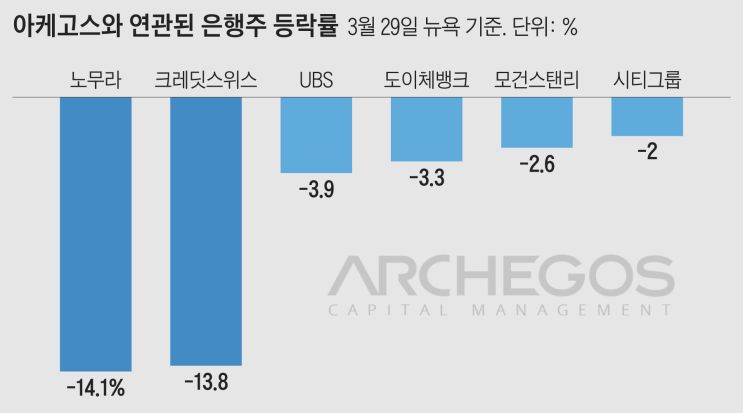
Archegos recently ran into this problem. Since February, long-term U.S. Treasury yields have risen, creating many stocks whose prices fell, and short sellers even exploited the gap. Because of this, stocks held by Archegos, such as ViacomCBS and Discovery, plunged this month. Nomura and others asked Archegos to deposit more money, but Archegos could not. Meanwhile, those stocks fell further, and starting last week, Nomura and others dumped them in large quantities, creating a vicious cycle of further declines. The banks found themselves unable to recover the money they lent Archegos even after selling all the shares, so they had no choice but to record massive first-quarter losses. ViacomCBS shares fell 52% over the past five trading days, Baidu 20%, and Discovery 41%.
An archegos must swim to shore and tie a rope to a rock so that others can land safely. The Jews called someone who did this an "archegos." That is why the word came to mean founder, guide, leader, among other things. In the Bible, it refers to Jesus.
Topics: Protestantism,Cathie Wood,~m 한계를 극복한 사람들
Category: Wiki/Person