Dow Theory
Dow Theory Principles
-
Averages reflect everything.
All factors known to affect both supply and demand are reflected in market prices. -
i style="padding-top: 20px;">There are three trends in the market.
According to the Dow, an uptrend continues to rise, and a downtrend continues to lower its highs and lows.
Dow believed that the law of action and reaction applies to the market just as in the physical universe, meaning that each important movement is followed by a specific reaction.Dow considered a trend to consist of the following three parts:
- Long-term trend (Primary Trend) (compared with the tide, reaching farther inland until it reaches its ultimate point)
- Medium-term trend (Secondary Trend) (compared with waves, representing a correction of the primary trend, generally retracing between one-third and two-thirds of the previous trend movement, most often about half of the previous movement)
- Short-term trend (Minor Trend, ripples) (fluctuations within the secondary trend)
-
Major trends have three phases.
Dow mainly focused on the major trend, distinguishing the following three phases:- Accumulation phase – The most astute investors sense a change in the current market direction and enter the market.
- Public participation phase – As prices rise rapidly, the majority of technicians begin to participate.
- Distribution phase – The new direction is now generally recognized and well known. Economic news confirms that speculation is increasing and public participation is growing.
-
Averages confirm each other closely.
Dow used to say that unless both the industrial average and the railroad average exceed their previous highs, there is no confirmation of the beginning or continuation of a bull market. The signals need not occur simultaneously, but the sooner one follows the other, the stronger the confirmation. -
Volume must confirm the trend.
Volume increases or decreases depending on whether prices move in the direction of the trend or in the opposite direction. Dow regarded volume as a secondary indicator. His trading signals were based on closing prices. -
A trend is assumed to continue until a clear reversal signal appears.
The overall technical approach to market analysis is based on the idea that a trend, like any other physical object, continues to move until an external force causes a change in direction. Of course, there are also reversal signals to look for.
Examining Patterns
Dow considered only closing prices. For an average to be significant, it must close above a previous high or below a previous low. Intraday penetrations were not included.
Failure Swing (Failure Swing. Failure Swing)
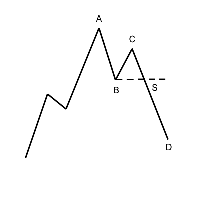
If C fails to surpass A and violates the low at B, it forms a "sell" signal at S.
Reversal Pattern (Nonfailure Swing. Nonfailure Swing)
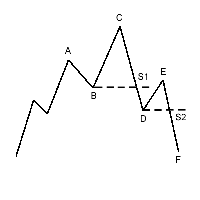
Note that C exceeds A before D falls below B. Some Dow theorists may see a "sell" signal at S1, while others need to see a lower high at E before they turn bearish at S2.
Failure Swing Bottom (Failure Swing Bottom)
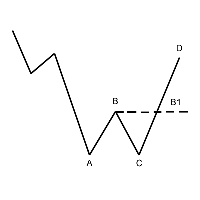
A "buy" signal occurs when point B is exceeded (at Bl).
Nonfailure Swing Bottom(Nonfailure Swing Bottom)
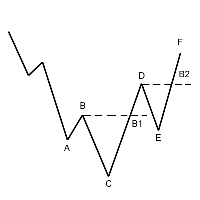
A "buy" signal occurs at point B1 or B2.
Related Topics
LIST file.aliases FROM [](#)
WHERE contains(topics, this.file.link) AND contains(tags, "#node/term")
GROUP BY link(file.link, file.aliases[0])
Topics: Economic Theory,Technical Analysis
Category: Wiki/Economy