goodwill
Goodwill
Generally, it refers to an asset that does not have legal protection but holds substantial social value through favorable business relationships. Typically, when a company has excess earning power compared to similar businesses, the excess earnings may be viewed as goodwill. It is also expressed as a premium, and when a business has excellent human resources, management capability, high social reputation, or a favorable location, it may be seen as the sum of such values that cannot be individually expressed.
Goodwill appears objectively in the case of corporate mergers and acquisitions. In other cases, even if goodwill actually exists, it is very difficult to quantify and identify its value in accounting, so it cannot be confirmed through financial statements.
Purchase Price Allocation
Purchase Price Allocation
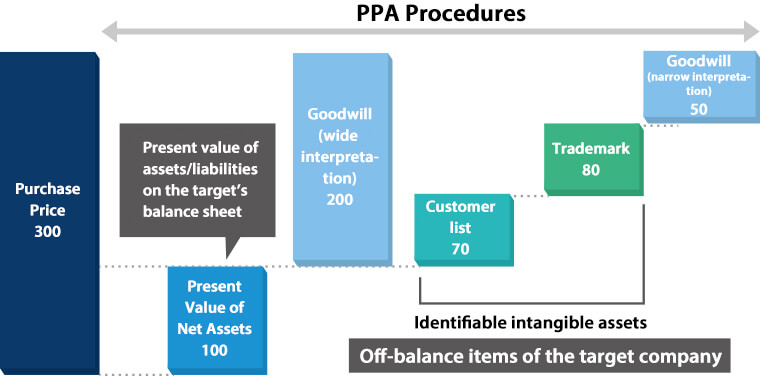
If the acquired company was purchased at a higher price than its book value, the excess paid must be set off against goodwill. (= premium)
Process
- First, calculate the company's net asset value
- Raise the assets that were undervalued among the company's asset values
- Amortize from goodwill
Example
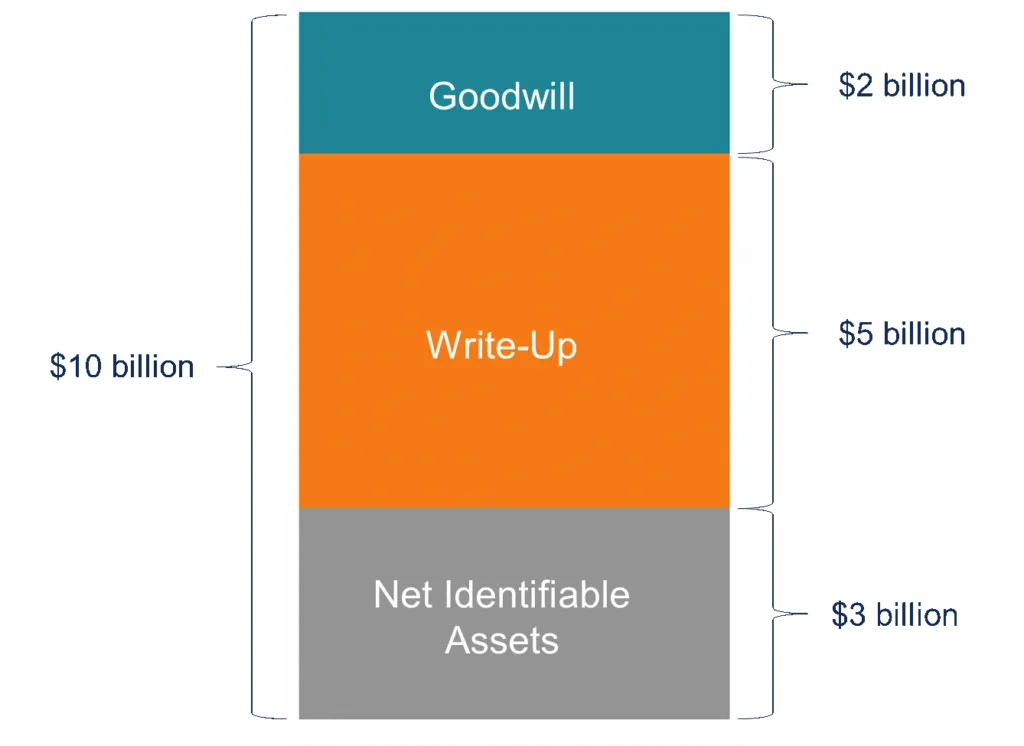
Company A recently acquired Company B for $10 billion. Following the completion of the deal, Company A, as the acquirer, must perform purchase price allocation according to existing accounting standards.

The book value of Company B’s assets is $7 billion, while the book value of the company’s liabilities is $4 billion. Therefore, the value of the net identifiable assets of Company B is $3 billion ($7 billion – $4 billion).

The assessment of an independent business valuation specialist determined that the fair value of both assets and liabilities of Company B is $8 billion. This finding implies that Company A must recognize a $5 billion write-up ($8 billion – $3 billion) to adjust the book value of the company’s assets to its fair market value.

Finally, Company A must record goodwill since the actual price paid for the acquisition ($10 billion) exceeds the sum of the net identifiable assets and write-up ($3 billion + $5 billion = $8 billion). Therefore, Company A must recognize $2 billion ($10 billion – $8 billion) as goodwill.
In Buffett's shareholder letters, it is said that under GAAP amortization is possible over up to 40 years; this seems worth checking.
writedown of goodwill
Amortization of Goodwill
If the acquired company was bought at a higher value than its asset value, the amount of goodwill is amortized against the company's profits. In Korea, the opposite case is recorded as a bargain purchase gain.
Topics: Mergers and Acquisitions
Link:: Reference Link
Category: Wiki/Economy