Long Wave Theory
Long Wave (Kondratieff Wave): Approximately 50-year cycle
A long-term cycle driven by technological innovation, war, and the development of new resources.
Medium Wave (Juglar Wave): Approximately 8–10 year cycle
A cycle related to corporate facility investment.
Short Wave (Kitchin Wave): Approximately 40-month cycle
A short-term cycle caused by money supply, interest rate fluctuations, price changes, and inventory fluctuations.
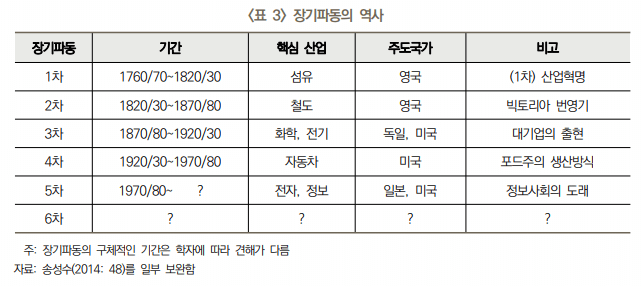
Cyclical fluctuations refer to long-term cycles of economic boom and bust caused by major technological innovations. This concept was first developed by the Soviet economist Kondratieff in the 1920s, who identified cycles of growth and decline lasting about 50 years, corresponding to innovations such as 18th-century cotton spinning machines and post-World War II mass production.
This theory emerged from debates on innovation using microelectronics, which was regarded as playing a leading role in escaping the recession associated with the fourth 'Kondratieff cycle' in the 1980s (Freeman, 1982).
However, the 1920s that formed the historical background of this theory differ from today. As the era of augmented reality becomes a reality, a phenomenon of "shortening of business cycles" has occurred, in which the cycles of all economic activities become shorter. For this reason, this long wave theory has long lost its influence in academia.
Topics: Economic Theory
Category: Wiki/Economy